Quick answer
Concrete may be smooth, dusty, sealed, painted, contaminated, or covered with weak laitance. A coating needs a surface condition that meets the manufacturer’s requirements. The preparation method should remove bond breakers and create a measurable profile rather than simply make the floor look cleaner.
Preparation creates the surface that the new coating must bond to
Concrete may be smooth, dusty, sealed, painted, contaminated, or covered with weak laitance. A coating needs a surface condition that meets the manufacturer’s requirements. The preparation method should remove bond breakers and create a measurable profile rather than simply make the floor look cleaner.
Diamond grinding and acid etching approach that job differently. Grinding mechanically removes concrete and coatings. Acid reacts with cement paste at the surface. Their capabilities, limitations, safety concerns, and consistency are not the same.
Diamond grinding uses abrasive tooling to cut the surface
A floor grinder equipped with diamond segments removes a controlled layer of concrete. Different tooling can address hard or soft slabs, coatings, adhesives, smooth troweled surfaces, and high spots. Edges require separate handheld equipment.
The result is a physically textured surface that can be compared with the coating manufacturer’s specified profile. Grinding can also reveal cracks, contamination, weak patches, and previous repairs that need attention.
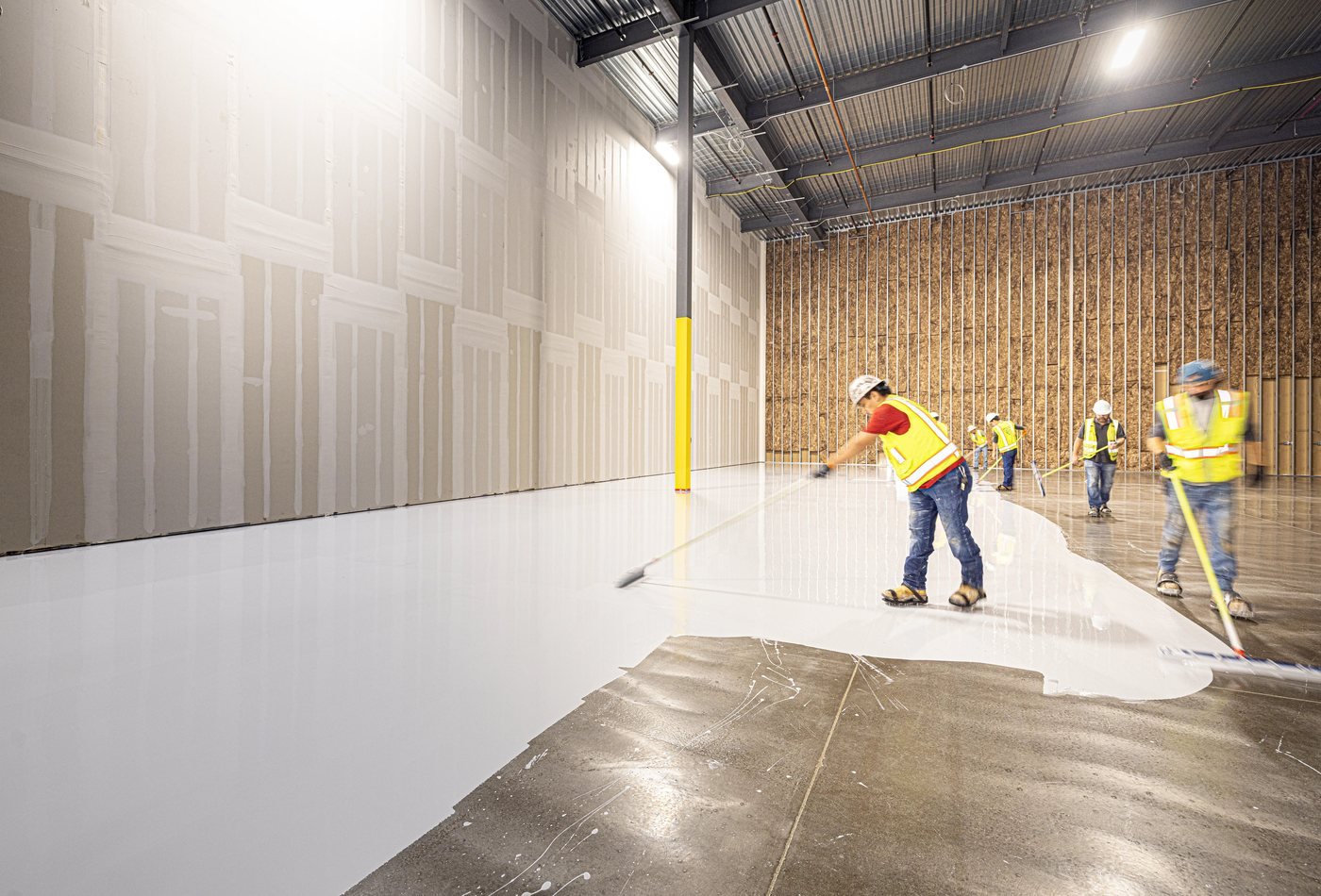
Acid etching chemically opens bare cement paste
Acid etching applies an acidic solution to bare concrete, allowing it to react with the surface. The floor is then scrubbed, thoroughly rinsed, neutralized as required, and dried. Consumer epoxy kits often include an etching product because the process uses inexpensive tools.
Etching can change the texture of suitable bare concrete, but its effect depends on the mix, finish, curing compounds, contamination, acid strength, dwell time, and application uniformity. It does not mechanically remove every obstruction.
Grinding is more effective for old paint, sealers, and coatings
Acid must contact cementitious material to react. Paint, epoxy, curing compounds, many sealers, oil films, and adhesives can shield the concrete. Acid may flow around those areas while leaving the bond-breaking layer in place.
Grinding can remove many of those materials and expose sound concrete, although thick or flexible coatings may require specialized tooling or shot blasting. A professional should identify what is on the floor before choosing equipment.
Mechanical preparation provides more consistent control
A contractor can select diamond tooling and passes to target a particular surface profile. The crew can inspect the scratch pattern, check gloss removal, and rework smooth areas. That repeatability is one reason grinding is common for professional resinous floors.
Acid reaction can vary from one part of the slab to another. Hard-troweled or sealed spots may react weakly, while porous areas react more aggressively. Uneven preparation can lead to uneven absorption and adhesion.
Neither method replaces degreasing and contamination assessment
Grinding over oil or silicone can spread contamination and load the tooling. Acid does not reliably remove petroleum products. Floors should be cleaned with appropriate degreasers and evaluated before and during preparation.
Deeply absorbed oil may require repeated treatment, localized removal, or patching. A floor that is visually lighter after grinding is not automatically contamination-free.
Dust control is a central part of grinding
Dry diamond grinding can create significant silica-containing dust if it is not paired with effective shrouds and industrial HEPA vacuum equipment. Professional crews should use dust-control practices and appropriate personal protective equipment.
Some fine dust can remain even with good collection. The slab and surrounding surfaces should be vacuumed before repairs and coating. Blowing dust around the garage is not an acceptable substitute.
Acid etching creates liquid handling and residue concerns
Acid solutions require chemical-resistant protective equipment, ventilation, protection of metal and landscaping, controlled rinsing, and lawful disposal. Residue or salts left in the slab can interfere with coating if the floor is not thoroughly rinsed and dried.
Using large amounts of water can also delay installation and introduce moisture into the slab. In an occupied home, runoff near walls, cabinets, drains, and driveways must be managed carefully.
Grinding can help flatten minor high spots but is not full leveling
A grinder can reduce small ridges, curled joint edges, and rough patches while preparing the floor. It can also feather repairs. However, it will not economically correct major slab slope, settlement, or widespread elevation differences.
Acid etching does not flatten the floor or remove raised defects. If the garage has trip edges or ponding, those conditions need a separate repair plan.
The coating manufacturer’s specification should decide the required method
Some consumer products permit acid etching on sound, bare concrete. Many professional high-build systems call for a mechanical profile, often described using ICRI Concrete Surface Profile numbers. The installer should follow the product system rather than choose the easiest preparation.
Ask to see the technical data or written system instructions. If a contractor proposes acid etching for a floor with old paint, sealer, or heavy use, ask how those materials will be fully removed.
DIY and professional goals may lead to different choices
A homeowner applying an entry-level kit to clean bare concrete may use the manufacturer-supplied etch and achieve an acceptable cosmetic result. That does not make etching equivalent to grinding for every system or expectation.
A professional quote usually carries a higher expectation for adhesion, repair, warranty, and long-term performance. Mechanical preparation is often part of delivering that higher standard.
Project checklist
Surface-preparation details to verify
- What materials currently cover or contaminate the concrete?
- What surface profile does the coating manufacturer require?
- How will perimeter edges, corners, and stem walls be prepared?
- What dust collection and silica-control equipment will be used?
- How will oil and silicone contamination be treated?
- How will old coatings and sealers be removed?
- How will the prepared surface be inspected before coating?
Frequently asked questions
Questions homeowners often ask
Is acid etching enough for epoxy?
It may be allowed for some consumer products on clean, bare concrete. Many professional systems require mechanical preparation, especially where paint, sealer, contamination, or a stronger bond profile is involved.
Does diamond grinding damage concrete?
Proper grinding removes a controlled surface layer and creates profile. Incorrect tooling or excessive grinding can gouge or expose aggregate, so trained operation matters.
Can pressure washing replace grinding?
Pressure washing cleans loose dirt but generally does not create the same controlled bond profile or remove many sealers and coatings.
Is grinding dust-free?
No process is completely dust-free, but shrouded equipment and industrial HEPA vacuum collection can greatly reduce airborne dust.
Technical references and further reading
Product data sheets and the coating manufacturer’s current instructions control the final installation. These sources provide useful background for comparing proposals.